Inside
10 things not to miss inside the palace
The museum route runs over two main floors, from the courtyards up to the grand hall and the ducal apartments above. You don’t need to see every room: these are the ten that tell the palace’s story best.
01Free to enter
Start in Michelozzo’s courtyard
The first courtyard was redesigned by Michelozzo in the 15th century. Its walls were painted in 1565 with views of Austrian cities to welcome Joanna of Austria, bride of Francesco de’ Medici. The putto with a dolphin on the fountain is a copy of Verrocchio’s bronze.
Good to knowYou can step into the courtyard without a museum ticket.
02Must see
Stand in the Salone dei Cinquecento
Built in 1494 for the 500-member Grand Council of the Florentine Republic, this is one of Italy’s largest Renaissance halls. Giorgio Vasari later raised the roof and covered the walls and ceiling with Medici victories (1555–1572), with Cosimo I glorified in the central ceiling panel.
Look forThe tiny words “Cerca trova” (“Seek and you shall find”) on a green flag in Vasari’s Battle of Marciano.
03Included
Find Michelangelo’s Genius of Victory
In a niche of the great hall stands Michelangelo’s marble Genius of Victory: a young man kneeling on an older captive. It was carved for the tomb of Pope Julius II in Rome but ended up in Florence after the artist’s death.
Detail to findWalk around it: the twisting spiral pose looks different from every angle.
04Hidden gem
Peek into the Studiolo of Francesco I
Off the great hall is a tiny, windowless room covered with paintings, designed by Vasari in 1570–1575 for Grand Duke Francesco I. He was fascinated by alchemy and nature, and the panels hide cupboards that once held his treasures.
Viewing tipOn the standard route you usually see it from the doorway. The Secret Passages tour goes inside.
05Included
See Donatello’s Judith in the Sala dei Gigli
The Room of the Lilies is named after the gold fleurs-de-lis on its blue walls. Here you’ll find Donatello’s bronze Judith and Holofernes, the original; the statue on the square outside is a copy. Next door, the Sala dell’Udienza has one of the palace’s richest carved ceilings.
Try thisLook at the marble doorway between the two rooms, carved by Benedetto and Giuliano da Maiano.
06Included
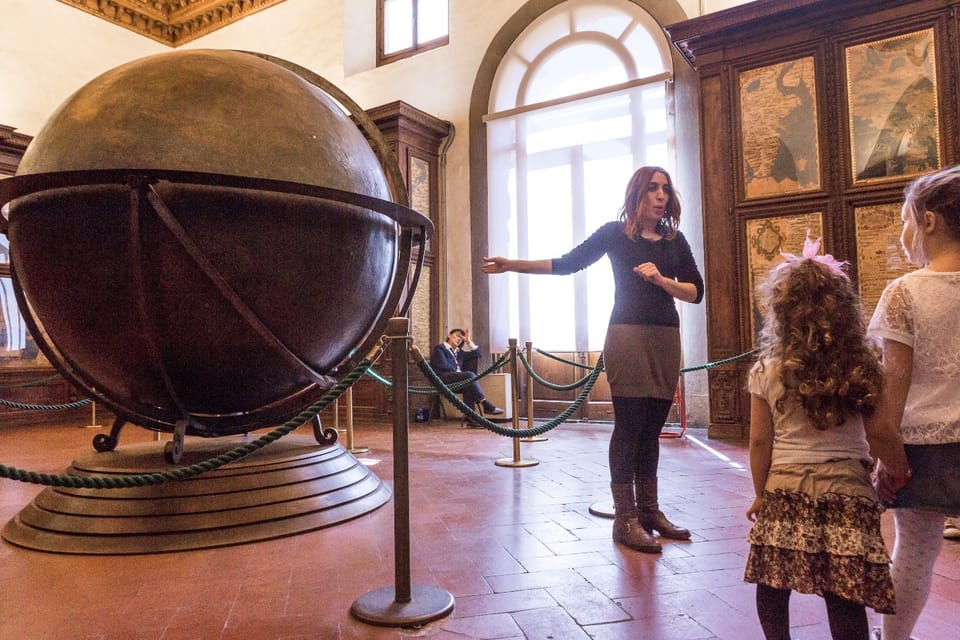
Spin the world in the Hall of Maps
The Medici wardrobe room is lined with wooden cupboards painted with maps of the known world in the 16th century, begun by Egnazio Danti from 1563. A large globe stands in the middle of the room.
Fun factThe maps reflect what Europeans knew around 1570, so look for oddly shaped coastlines.
07Included
Visit Eleonora’s apartments and chapel
The rooms of Eleonora di Toledo, Cosimo I’s Spanish wife, are more intimate than the state halls. Her small chapel was painted by Bronzino in the 1540s, and the Camera Verde (Green Room) is decorated with grotesques.
Better viewing rhythmVisit after the great hall to feel the shift from public power to private life.
08Easy to miss
Find Dante’s death mask
A plaster mask traditionally believed to be Dante’s death mask is displayed on the upper floor. The poet was exiled by the government that met in this building.
WhereAsk staff if you can’t find it; it is in a small passage rather than a main hall.
09Guided activity
Take the Secret Passages tour
Run by the museum’s own education team, this small-group activity opens spaces closed to normal visitors. Routes typically include the hidden staircase of the Duke of Athens, the Studiolo and Cosimo I’s Tesoretto (treasury), and the huge wooden roof trusses above the great hall.
Book aheadPlaces are limited and the activity is charged on top of museum entry.
10Separate ticket
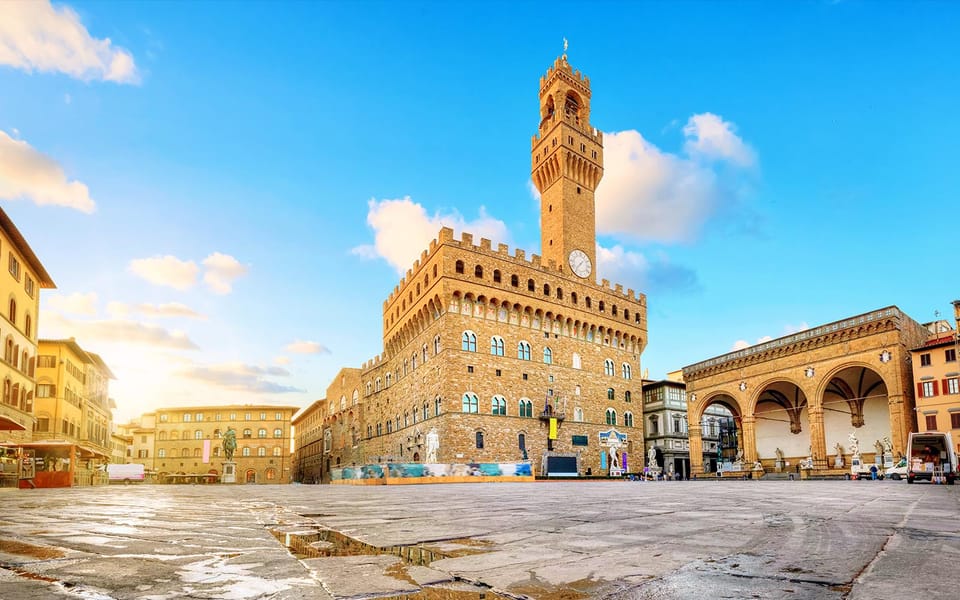
Climb Arnolfo’s Tower
The 95-metre tower has a narrow stone staircase of over 200 steps to the top lookout. On the way you pass the small cell where Cosimo the Elder (1433) and Savonarola (1498) were imprisoned.
Before you add itNot accessible for wheelchairs or strollers; children under 6 can’t go up. Closes in rain.